Advertisement · Paid partnership

About this content

Garden & Craft · Advertorial

The Lost Art of the British Breeze

Plastic spinners fade, squeak, then go in the bin. A retired tinsmith in a Vermont barn is still making them the other way — in tin, by hand, one at a time.

By Web Jaguars LTD9 November 20268 min read
A handcrafted tin whirligig wind spinner in an English cottage garden at dawn
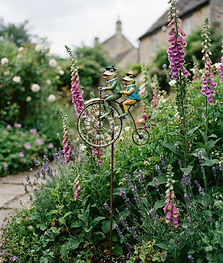
Frogs on a Penny-Farthing whirligig among foxgloves
Frogs on a Penny-Farthing

Every autumn, Britain's garden centres fill up with the same three things: bulbs, bird feeders and wind spinners moulded in plastic. They cost about a tenner, they look cheerful until roughly February, and then the paint chalks over, the bearing seizes, and the whole thing ends up behind the shed.

There is an older way of doing this. Tin cut and hammered and folded and soldered by hand; enamel made to survive salt air and frost; a bearing that turns on the lightest breath of air rather than waiting for a gale. It is how garden ornaments were made before they were engineered to a price.

Which is how a hand-shaped tin whirligig from the Northeast Kingdom of Vermont — a place whose winters are about as forgiving as a Yorkshire moor — ended up in British gardens by way of a small craft shop. It is called the Vermont Whirligig, and it makes the plastic version look like exactly what it is.

Why the cheap ones never last a British winter

The weak point is almost never the shape. It is where the shape is joined, and where it turns.

A typical mass-market spinner hangs its figures on a steel rod dropped through a hole in a stamped bracket. There is no bearing — only metal on metal and a smear of grease that washes away by November. Add a damp British winter, a hard frost, and the grit that comes off a path with it, and the ornament starts to squeak. A spinner that squeaks is a spinner that has already begun to fail.

The seams matter as much. Stamped figures are folded together and crimped, sometimes spot-welded, which leaves a capillary gap for water to sit in. Water sits, frost expands, the paint lifts — and by the second spring the thing is a rust-coloured outline of itself. Then there are the printed decals that pass for paint, and the moulded plastic figures that go chalky under one summer of sun.

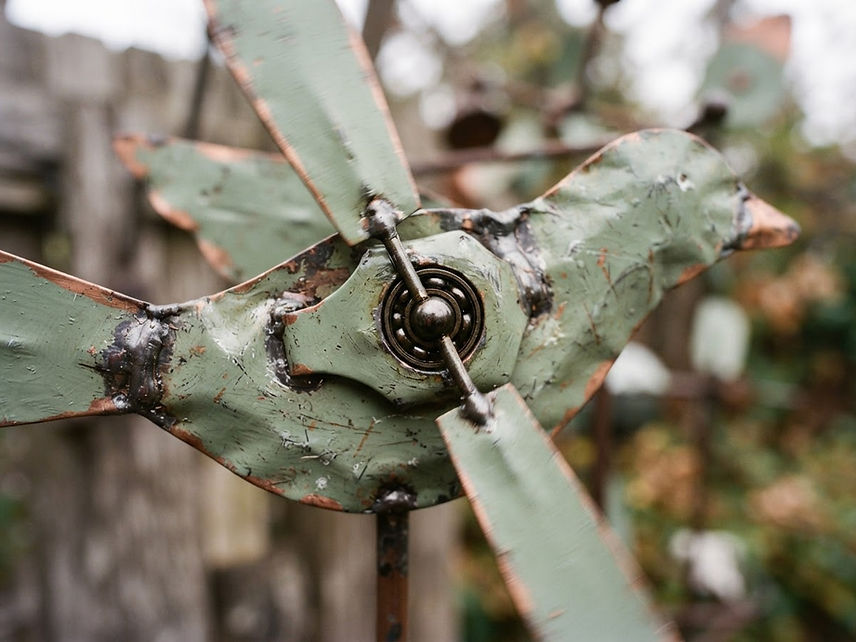
Macro view of hand-hammered, hand-painted tin with soldered seams and a small sealed bearing
Fig.The tell is in the seams: hand-folded tin, soldered and painted rather than stamped and printed. Illustrative image.

None of this is a moral failing on the part of garden centres. It is what a £9.99 price point buys. The more useful question is what a different price point buys — and whether, over ten years, it is actually the cheaper thing.

Meet the tin man of the Northeast Kingdom

Russ Holcomb spent a working lifetime in tin. He is retired now, and he works alone in a small barn workshop in Vermont, shaping old food cans and salvaged bicycle parts into objects that look as though they came out of a 1950s hardware catalogue — which, in a sense, they did.

The techniques are roughly fifty years old, of the kind most craftsmen no longer bother with. Joints are triple-tinned and soldered so the seal holds from the inside out. Each wheel runs on two sealed ball bearings. The paint is a marine-grade enamel, applied by hand, chosen because it resists UV, frost and salt air rather than because it is cheap. The ground stake is solid steel.

Whichever design you choose, the engineering is identical; only the joke on top changes. Every piece is balanced and tuned on the same workbench before it leaves the barn.

One of the designs has a story attached. The frogs — a pair riding a penny-farthing, he in a top hat, she in a bonnet — go back to a Vermont swimming hole, some lily pads, and a woman called Helen, fifty years ago this autumn.

Weathered hands shaping reclaimed tin with hand tools on a worn workbench in a barn workshop
Fig.Hands, tin snips and reclaimed tin: the workshop method has not changed in half a century. Illustrative image.

It is worth saying plainly what that means for a buyer. There is no factory, no batch of ten thousand, and no plan to make one. What there is, is a man in a barn with a pair of snips, a soldering iron and a bench that has been the same bench for decades.

“A stamping press will produce ten thousand identical shapes by Friday. A pair of hands makes the one that is still turning in twenty years.”

Three designs, one set of engineering

The range is small on purpose. Three designs, each one a pair of characters on a machine that has no business being that small: a penny-farthing, a 1950s motorcycle, a low chopper.

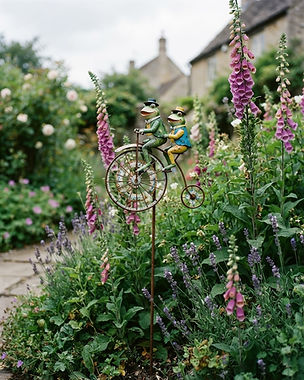
Handcrafted tin wind spinner of two frogs riding a penny-farthing bicycle among foxgloves

Bestseller

Frogs on a Penny-Farthing

Russ's signature piece: a pair of frogs in top hat and bonnet aboard a vintage high-wheel bicycle, hand-painted in tannic green with bright accents.

Choose this design
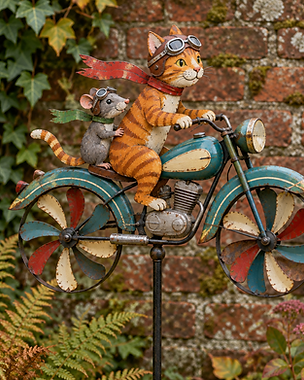
Handcrafted tin wind spinner of an orange tabby cat and a grey rat riding a 1950s motorcycle

Character favourite

Cat & Rat on a Motorcycle

An orange tabby with a determined grin and a grey rat in a leather jacket, riding a 1950s-style motorcycle in marine-grade enamel.

Choose this design
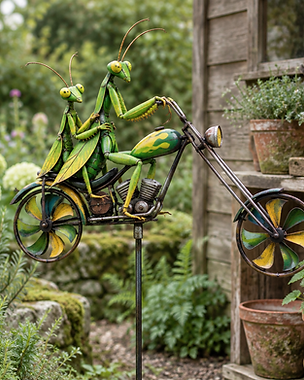
Handcrafted tin wind spinner of two green praying mantises riding a chopper motorcycle

Most sculptural

Praying Mantis Pair on a Chopper

Two praying mantises on a low chopper, long legs gripping the bars. The most sculptural of the three, in fresh green and yellow paint.

Choose this design

Whichever you pick, the specification underneath is the same: the same triple-tinned soldering, the same sealed bearings, the same enamel, the same solid steel stake. The frogs are the bestseller — they are also the one with the story — while the mantis pair is the most sculptural of the three.

What the money actually buys

At $44.99 for a single piece, this is not the cheapest spinner you can push into a border, and it is not pretending to be. So it is worth being specific about where the difference goes.

01Triple-tinned soldering
Every joint sealed against moisture from the inside out, so water has nowhere to sit and frost has nothing to lift.
02Reclaimed American tin
Hand-shaped from old food cans and salvaged bicycle parts — heavier gauge than stamped, mass-produced spinners.
03Sealed ball bearings
Two in every wheel. It turns on the lightest air instead of waiting for a gale, with no squeak and no oiling.
04Marine-grade enamel
Hand-painted, UV-resistant, frost-proof and salt-air tested. Colour that is meant to last decades, not seasons.
05Solid-steel ground stake
Mounts straight into a border, a lawn edge or a pot, and stays upright through a British winter.
06Tuned by hand
Every piece is balanced on the same workbench before it leaves — the part you cannot see from the photograph.

The arithmetic that matters is replacement, not ticket price. A tenner spent every other season — and a small, quiet annoyance every time it fails — against a soldered, bearinged piece that is built to outlast the person who bought it. Nobody buys a garden ornament as an investment. But it is reasonable to want the thing you put in the border to still be there in five years.

Old tin and the tenner spinner

Set side by side, the differences are not subtle. This is what changes when something is made by hand at a bench rather than stamped to a price:

How it turns

Typical:Steel rod dropped through a hole

Handmade:Two sealed ball bearings per wheel

Joints

Typical:Crimped, sometimes spot-welded

Handmade:Triple-tinned, soldered inside and out

Surface

Typical:Printed decal film over thin steel

Handmade:Hand-painted marine-grade enamel

Figures

Typical:Moulded plastic on a metal arm

Handmade:Hand-shaped reclaimed tin

Wind needed

Typical:A decent breeze, and usually a squeak

Handmade:The lightest breath of air

Second winter

Typical:Chalked paint, seized bearing, binned

Handmade:Still turning, still quiet

Comparison with typical mass-market garden spinners, based on the retailer's materials specification.

Where it earns its place in a British garden

The obvious objection is that this is a garden ornament from Vermont, being sold to people with a different climate and a different idea of what a garden is for. In practice it is the reverse: wet, cold, salt-laden air is precisely what this kind of build was designed against.

  • In a winter border. When the perennials are down to stems and the garden is at its least interesting, a moving object gives the eye somewhere to go. January is the month it earns its keep.
  • Coastal gardens. Salt air is what destroys garden metalwork on the Norfolk and Cornish coasts. Sealed seams and a marine-grade enamel are the two things that answer it.
  • Allotments and potting sheds. A small, faintly absurd moving thing beside the compost bin is a pleasure that costs nothing once it is in. It also survives being left alone for a fortnight.
  • Small gardens and courtyards. It takes up the footprint of a fork and gives you vertical movement without planting a tree or waiting ten years for one.
  • A gift for someone who gardens. It arrives with a maker, a method and a story attached — which is more than most Christmas presents for gardeners manage.

It is not a statement piece, and it is not trying to be. It is the thing you notice from the kitchen window on a blustery Tuesday — which is, arguably, the entire point of a garden ornament.

Average rating
4.8Average rating
Customer ratings
734Customer ratings
Days to dispatch
2–3Days to dispatch
Day return window
90Day return window

Figures as listed on the retailer's product page, 9 November 2026. Insured, tracked shipping is included per their listing.

Questions people actually ask

Is it genuinely handmade, or is that just the marketing?

Each whirligig is hand-shaped, hand-soldered and hand-painted, one piece at a time, which is why no two are exactly identical. Small variations in the paint and the hammer marks are part of the object, not a fault.

Will it survive a British winter?

The build is aimed squarely at it: seams soldered shut from the inside out, sealed ball bearings rather than an open rod, and a hand-painted enamel the retailer describes as UV-resistant, frost-proof and salt-air tested. The full materials specification is on the retailer's product page.

Does it need a windy spot?

No. That is the point of the bearings — it is tuned to start turning in the lightest air, so a sheltered garden or a courtyard works as well as an exposed one.

Does it squeak or need oiling?

The wheels run on sealed ball bearings, so there is nothing to lubricate and no metal-on-metal contact to squeal. That is the single biggest difference from a rod-in-a-hole spinner.

What does it cost, and are bundles cheaper?

A single whirligig is listed at $44.99. Two work out at $89.98 ($40.49 each), three at $134.97 ($38.24 each) and four at $179.96 ($35.99 each) — free shipping is included on each bundle as listed. Prices are in US dollars; your bank converts at checkout.

Can I mix designs in a bundle?

Yes. On the retailer's page you choose a design for every unit in the bundle, so a two-pack can be one of each.

Does it ship to the UK, and what about returns?

The retailer's checkout lists the destinations it currently ships to, with delivery costs and timescales, before you enter any payment details. Returns run on their 90-day policy, and both delivery and returns are handled by them rather than by us.

The offer

Vermont Whirligig — Handcrafted Tin Garden Wind Spinner

Hand-shaped, hand-soldered and hand-painted in Vermont. Three designs, one set of engineering, and a bearing that turns on the lightest air.

  • Handmade, one piece at a time
  • Ships within 2–3 days
  • Insured, tracked shipping
  • 90-day return policy

Bundle prices

1 × Whirligig
$44.99
2 × Whirligigs$40.49 each
$89.98
3 × Whirligigs$38.24 each
$134.97
4 × Whirligigs$35.99 each
$179.96
Continue to checkout

Prices in US dollars, as listed by the retailer on 9 November 2026. Your bank converts the amount at checkout.

Sources & notes

Product and prices
Details, prices and bundle rates as published on the retailer's Vermont Whirligig product page, retrieved 9 November 2026. Prices and availability can change.
Imagery
Photographs on this page are illustrative. The retailer's product page shows the exact piece being sold and any natural variation between handmade units.
Ratings and policies
The rating, dispatch time and return window quoted here are the retailer's own figures as listed at the date above. Delivery, payment, returns and after-sales service are provided by the retailer.
Advertising
This page is paid promotional content produced by Web Jaguars LTD, a marketing partner of urban-planet.com. We may receive a commission on orders placed through our links.